
Exploring Cyanotype Printing
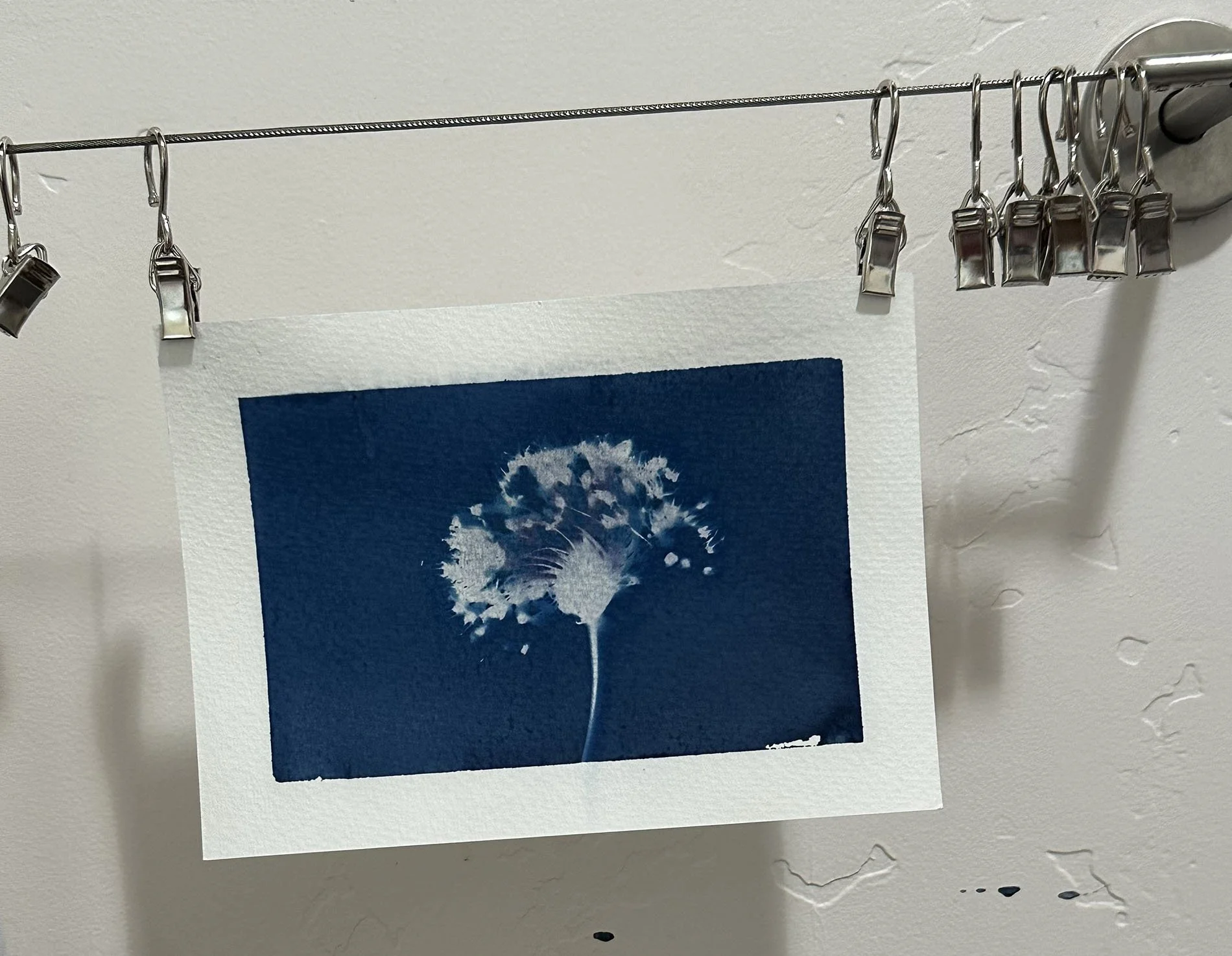
Cyanotype printing of an Allium from the
My first experience creating with Cyanotype was when I was an undergraduate at Purdue University. It was in one of my photography classes. I found an advertisement for a dance performance. The paper was purple. I copied sheet music on clear mylar, coated the paper with the cyanotype medium and placed the music sheet over it and set it out in the sun. The sheet music acted like a photographic negative and the cyanotype mixture like the photography processing chemicals. The sun was the light exposure that set everything in motion. The result was awesome! So much so that 39 years later I still have the image!
Fast forward to my last term teaching at CMU. My 2-D design class was in the print room. One morning while preparing for class, I came across a book Cyanotype: The Blueprint in Contemporary Practice by Christina Z. Anderson. I thought the book intriguing, and I took a picture of it so I could research it later. Fast forward again about a year later, I retired from teaching and decided to order the book and start experimenting with Cyanotype printing.
Andy had given me this incredible handmade sketchbook for Christmas. The cover is a patchwork of leather, and the pages are all handmade paper. The book was so beautiful I didn’t want to work directly in it for fear I’d create a crappy drawing or painting, so what to do? I decided to create work on a separate sheet of paper and then adhere it into the sketchbook. Great idea, however, if the paper I’m adding is too thick it would make the pages too thick and thus the book would not be able to close properly. My solution was to use rice paper, also handmade, which is very thin in comparison to most art papers.
So now what to put on the paper? If I was going to create a book, it needed to have a consistent feel to it, a theme if you will. This is when I decided to use the Cyanotype printing process as my medium and the Flowers and things that grow on our property as my subject matter! And so, the Cyanotype experimenting began.
At first, I thought I’d have to mix my own Cyanotype chemicals but upon further research I discovered you can order the chemicals and just add water… so much easier! Why reinvent the wheel if you don’t have to! Of course, there are a lot of different varieties of rice paper, so I purchase several different kinds and began to experiment. In the end, I decided the Mulberry paper was the strongest while remaining thin in weight.
While printing with the Mulberry paper, I also started to experiment with watercolor paper, specifically watercolor paper post cards. This is how my “Postcards from Palisade” series started! I’m still printing on postcards and at some point, I’m going to send them to friends to see how they hold up in the mail. If it works not only, will I be sending my friends a little note to say hello, I will also be mailing them an original one-of-a-kind piece of art! If this stage of the exploration works than one, I master the printing process itself I can create postcards to sell as well!
While all this experimentation was going on, I saw a video on Instagram about creating a Cyanotype print on fabric! Soooo…. I decided to try my hand at that as well! But what to print on? Clothing? Home goods? A friend suggest printing on a scarf and another friend suggested a tea towel. The scarves were expensive whereas the tea towels were not, so I opted to start with the later and order several plain white cotton tea towels (aka dish towels). I also ordered some whine linen cocktail napkins as well as cotton dog bandanas! Daisy always has a bandana on so I thought why not make her one… and if that works then I can sell them to others who have beloved fur babies!
So, in addition to making prints for my book and the Postcards from Palisade series, I’ve started printing on fabric. The dog bandana was a great success; however I think I need to order another size up, go from a larger to an extra-large. The cocktail napkins are super cool in my opinion. I printed a set of four using lavender flowers from my neighbor’s garden. I’m going to create another set of four using snapdragon flowers from my garden!
The first tea towel was an absolute disaster! When I applied the Cyanotype mixture it bleeds. To fix this I thought if I covered up the uneven bleed with masking tape it would create a clean edge as the sun could not process through the tape. Turns out it can! So, I had the beautiful lavender image along with bad masking tape imagery! I threw the whole towel out… didn’t even bother processing it as I knew what the outcome would be… a great big BLAH!
So, I started over with the tea towel and leaned into the bleed. I applied the Cyanotype to a corner of the towel and let it do its thing. Once it was dry, I arranged the Lavendar in a fan like pattern to mimic the pattern of the bleed and put it out in the sun to process. This time it worked! However, I think I over processed it (meaning I left it in the sun too long) and the Lavendar isn’t as pronounced as I would have liked; but the blue of the Cyanotype looks great! So now I’m thinking about ways I can incorporate more of the towel, without making it completely blue. I’m going to continue to work with the bleeding and experiment to see how I can make it even more purposeful, perhaps incorporating some “Jackson Pollock drip strategies and use flowers that have a similar drip like pattern to their petal construction. Or… as I look at the fresh cut bouquet that is sitting on my studio worktable… maybe I create a bouquet on the tea towel incorporating drips and splatters and a variety of flowers from the garden! The possibilities are endless which is what makes creating these functional works of art so much fun!
